






Procurement in Construction
Contents |
[edit] Introduction
Construction projects are highly complex, with buyers and sellers often filling multiple roles as project stakeholders. Construction projects have a complex web of different stakeholders: buyers and sellers, owners, clients, contractors or developers - plus an array of specialised vendors like architects engineers and suppliers. Relationships between owners, general contractors, subcontractors and suppliers all exist on varying levels of contractual agreement in order to bring the entire endeavour to a successful completion.
Procurement in construction is conducted to better delegate the performance risk amongst these players who specialise in various fields. The procurement process might be repeated hundreds of times on big scale builds for one organisation alone! Procurement in construction carries with it a substantial financial burden - any missteps can have disastrous implications not just for the project owner, but throughout related hierarchies. To avoid this pitfall, even experienced professionals should ensure their contract management and scope knowledge is up-to-date and compliant with relevant legal standards.
[edit] Contractor’s Perspective
For contractors hoping to land the perfect job, bidding can be an extensive and costly exercise. When a successful bid is placed, contract clauses dictate that both buyers and sellers enter into agreement with one another.
Making sure scope, risk factors cost and time are managed properly during this competitive procurement process requires careful consideration of what products or services should be obtained internally versus externally by subcontractors or tradesmen.
As construction practices evolve there are more opportunities than ever before for contractors to show their mettle; by directing subcontractor activities effectively you can prove yourself capable of tackling even the most ambitious projects!
[edit] Owner’s Perspective
With every new construction project comes a number of factors that can heavily influence the cost, timeline and process. From specialised or hybrid contracting methods to fast-tracking projects for quicker outcomes - there are plenty of opportunities present to make decisions that will ultimately determine success.
Fast tracking is one technique to compress schedules which involves concurrently running design and construction stages- sometimes with design decisions made onsite.
See also: Procurement route.
[edit] Reference
Author(s) : Project Management Institute, Inc. (2016)
Name of publication : Construction Extension to the PMBOK® Guide
Place of publication : Newtown Square, Pennsylvania 19073-3299 USA
Name of publisher : Project Management Institute, Inc.
[edit] Related articles on Designing Buildings
Featured articles
Check out some of the best features and news from Designing Buildings as well as key stories from around the web.
Undervaluing our industrial past

Heritage value changes as taste for building styles changes.
Changing expectations around competence and compliance

New information sheet from CIAT.
Grenfell investigation files passed to CPS

Angela Rayner apologises on behalf of the British state.

Electrical contractors need to understand the practical implications.

The real barrier to getting more value from digital technology.

Your guide to The Construction Reset at UKCW Birmingham.

Accommodating the Victorian and Edwardian working woman. Book review.
Rethinking passive fire protection in design

PFP demands the same level of design rigour as structure or services.

38% of Gen Zs feel safe when a fire door is wedged open.
Stunning images from around the world

Shortlist for CIOB’s Art of Building photography competition.

Guidance for conversion of traditional pre-1919 stone buildings.
Industrial heritage in the Ruhr
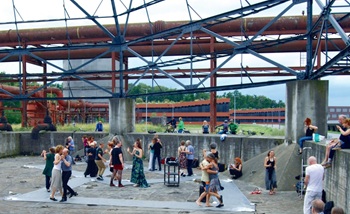
A marked difference to the fate of industrial landscapes in the UK.
Comments
[edit] To make a comment about this article, or to suggest changes, click 'Add a comment' above. Separate your comments from any existing comments by inserting a horizontal line.